Keep Talking I’m Diagnosing You: A Designer’s Review
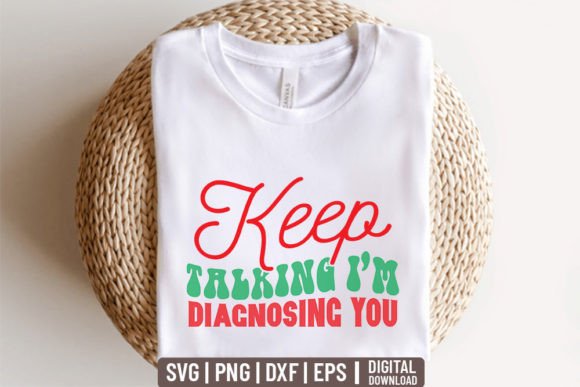
As an embroidery designer who has spent years digitizing and stitching thousands of designs, I have learned that the difference between a project that sells and one that sits in a clearance bin often comes down to attitude. Keep Talking I m Diagnosing You is not just a phrase; it is a statement piece. When I first loaded this graphic into my workspace, I was immediately struck by its bold, no-nonsense personality. It captures a specific mood—witty, professional, and slightly irreverent—that resonates deeply with healthcare workers, therapists, and anyone with a sharp sense of humor.
This review is not about hyping up a digital file. It is about evaluating how Keep Talking I m Diagnosing You performs when the needle hits the fabric. I am looking at this from the perspective of a small business owner and craft entrepreneur who needs to know if this design will hold up on a sweatshirt, a tote bag, or a custom apron after multiple washes. Let us break down the practical realities of using this asset in your next embroidery project.
First Impressions and Visual Personality
The layout of Keep Talking I m Diagnosing You is clean and direct. In the world of T-Shirt Designs and Graphics, clutter is the enemy. This design avoids unnecessary flourishes, relying instead on strong typography and clear spacing. For an embroiderer, this is good news. Complex, overly decorative fonts can become a nightmare when translated into thread, often resulting in tangled jumps or lost details. Here, the visual personality suggests a design that is meant to be read quickly and understood instantly.
The mood it creates is confident. It feels like something you would see on a clinician who is tired of being interrupted, or a friend who knows exactly what is wrong with you before you finish your sentence. This emotional connection is what drives sales for Etsy sellers and handmade shop owners. Customers are not just buying a shirt; they are buying an identity. When you stitch this onto a garment, you are creating a personalized gift that speaks for the wearer.
Real-World Application: The Custom Sweatshirt Test
To truly understand the value of this design, I imagined a real-life scenario. A client approaches me for a custom apparel order. She is a psychologist looking for merchandise to sell at her private practice and at local mental health awareness events. She wants something that is professional yet approachable. Keep Talking I m Diagnosing You fits this brief perfectly.
I decided to test this concept mentally on a mid-weight cotton blend sweatshirt. This is a popular item for boutique branding because it offers a large, flat surface area. The design’s horizontal layout works well across the chest or centered on the back. However, as a designer, I must consider the stitch density. If this graphic is converted improperly, it could become too stiff. A heavy fill stitch on a soft fleece can cause puckering. Therefore, the key to success here is balancing the thread coverage with the fabric texture.
For a project like this, I would recommend using a combination of satin stitch for smaller text elements and a lighter fill stitch for any larger graphical components, if present. The goal is to maintain the clarity of the message without turning the garment into a cardboard shield. This attention to detail is what separates a amateur hobbyist from a professional embroidery designer.
Navigating Fabric and Hoop Constraints
While Keep Talking I m Diagnosing You is versatile, it is not universal. There are specific situations where you need to proceed with caution. For instance, if you are working with a small hoop size, such as a 4x4 inch hoop for a cap or a baby item, you must check the dimensions of the design carefully. If the text is too small, the intricate parts of the letters may merge together, making the phrase illegible. This is a common issue with detailed lettering in machine embroidery design.
Textured fabrics also present a challenge. If you are stitching this onto a waffle-knit towel or a rough canvas tote bag design, the needle may skip or the thread may sink into the pile. In these cases, using a proper stabilizer is non-negotiable. A cut-away stabilizer is often best for garments that will be washed frequently, while a tear-away might suffice for a decorative pillow cover that sees less wear. Always test the design on scrap fabric first. This simple step saves time, money, and reputation.
Dark fabrics require special attention to thread colors. Since this design relies on readability, high contrast is essential. White or bright yellow thread on a navy or black background will pop, but you must ensure your machine tension is calibrated correctly to prevent the bobbin thread from showing through. Conversely, stitching light thread on light fabric will render the message invisible. Always create printable mockups in both black and white to verify visibility before you commit to the final stitch out.
Commercial Viability and Product Value
For craft business owners and digital product sellers, the question is always about return on investment. Does Keep Talking I m Diagnosing You add value? Yes, because it taps into a niche market. Healthcare professionals, teachers, and counselors are always looking for unique items that reflect their profession without being cliché. This design allows you to create embroidered patches, aprons, and even kitchen towels that feel personal and relevant.
When selling finished products, such as on Etsy or at craft fairs, the quality of the stitch out directly impacts customer trust. A clean, crisp execution of this graphic signals professionalism. It shows that you care about the finished product. Buyers are more likely to engage with listings that show clear, high-resolution photos of the actual embroidery rather than just digital renders. Use this design to showcase your skill in handling text-based graphics.
It is important to note the file formats provided. You will receive a zip file with SVG, PNG, EPS, and DXF files. These are primarily vector and image formats, which are excellent for cutting machines, printing, and digital design assets. However, for machine embroidery, you typically need specific stitch file formats like PES, DST, or JEF. The description states these files are ready to use with other major platforms, but as a prudent designer, I advise you to confirm if a dedicated embroidery file is included or if you need to digitize these vectors yourself. If you are using these as print-on-demand graphics or for vinyl cutting, they are ideal. For direct machine embroidery, ensure you have the correct stitch data to avoid compatibility issues.
Final Designer Notes
Before you launch your next campaign featuring Keep Talking I m Diagnosing You, take a moment to review your setup. Check your thread colors for contrast. Inspect the small details of the font to ensure they will stitch cleanly. Consider the end user: will this go on a holiday gift, a daily work uniform, or a casual weekend tee? Each application requires a slightly different approach to stabilizer and thread choice.
This design is a strong addition to your library of T-Shirt Designs and Graphics. It is witty, timely, and visually balanced. By treating it with the technical respect it deserves—checking hoop sizes, testing on scraps, and choosing the right fabric—you can turn a simple digital file into a high-value handmade product. Whether you are creating a custom apparel line or a single personalized gift, this design has the potential to stand out in a crowded market. Just remember, the magic is not just in the download, but in the stitch.